Akagera National Park · Rwanda
Wildlife of Akagera
National Park
What you will see, where in the park to find it, and what it took to bring it back. From the people who run game drives here every day.
Big Five · 500+ bird species · 1,122 km²In 2015 there were no lions in Akagera National Park . The last one had been poisoned years earlier — retaliation for livestock kills, the same fate that took the black rhinos before them. When we started running safaris here, guests would ask about lions and we had to be honest: they were gone. Two years later seven were brought back from South Africa. Now there are 62. We have watched this park rebuild itself species by species and we know every corner of it. This guide is what we tell guests before they arrive.
The Big Five
Lion, elephant, rhino, buffalo and leopard
Akagera is the only place in Rwanda where you can see all five. Each one has a different story in this park — different odds, different areas, different times of day. Here is what to know before you go out.
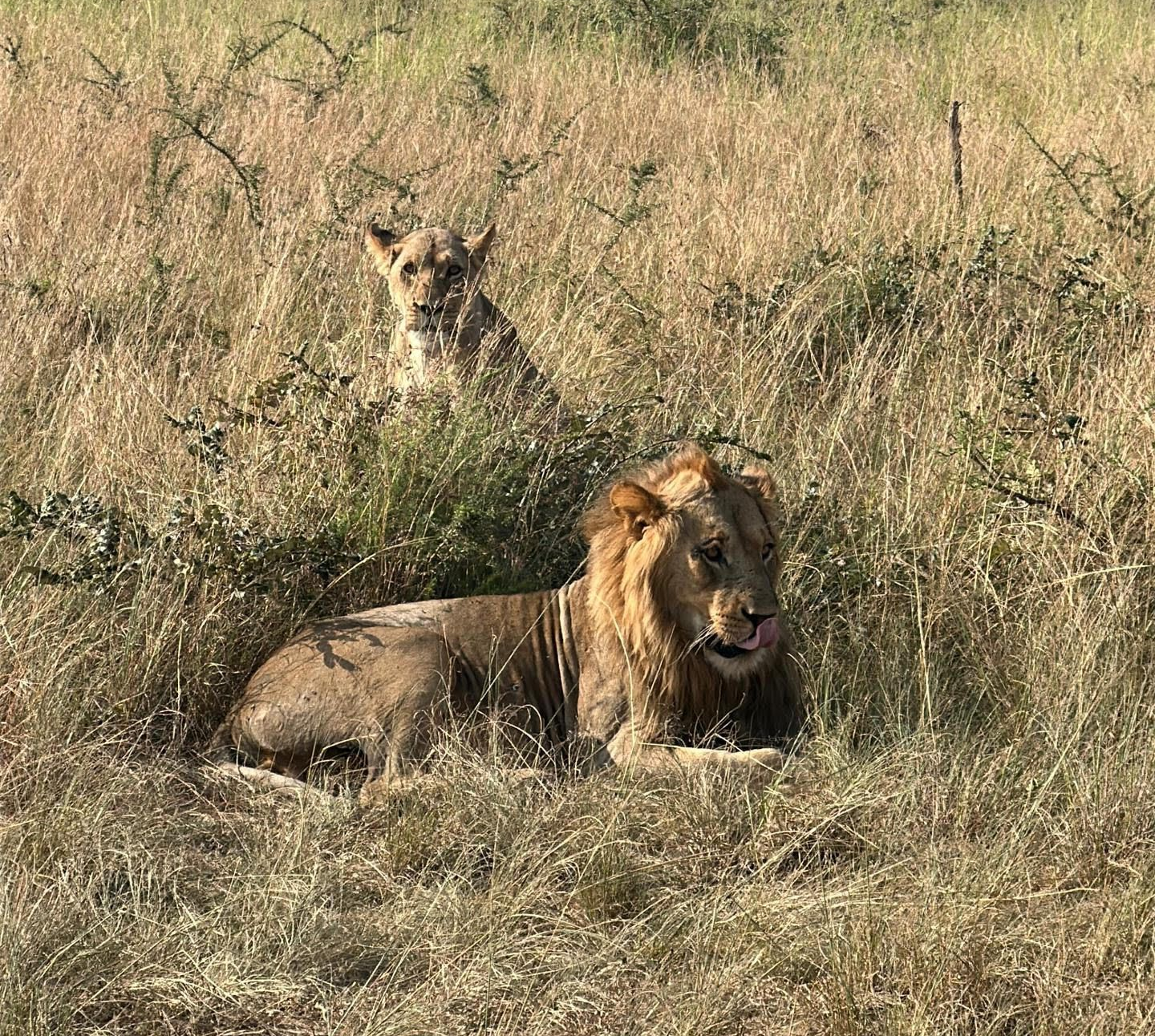
Lion — back since 2015
- 62 lions in the park as of the latest count
- Brought from South Africa — they had been extinct here since the early 2000s
- They move across the whole park following the herds — south or north, wherever buffalo and zebra concentrate
- Your best odds are in the north where the open Kilala Plains give them nowhere to hide
- On a game drive in the south you are looking into shrubs and woodland — they could be 20 metres away and you would not know
- For most people a safari isn't over until they see a lion. Akagera has 62. The odds are in your favour.
African elephant
- Two separate herds — one in the south, one in the north — up to 60 individuals each
- They rarely meet. When they do cross paths they sometimes turn around and go back
- The southern herd descends from 26 individuals relocated to Akagera in 1975 when elephants had disappeared from the park entirely
- Muhana Plains between south and north — this is where you will not miss them
- Lakes Hago and Nyamheke in the far north — elephants move here and stay for entire weeks at a time
- Between the gate and reception, lone bulls pass close to the road and seem completely unbothered by the vehicles
Rhinoceros — eastern black & southern white
- 18 eastern black rhinos came from South Africa in 2017. Five more in 2019. Calves have been born here since
- 30 southern white rhinos were added in 2021. 70 more arrived in June 2025
- Go to the Kilala Plains in the north. The terrain is open and flat. You will find them
- They are dehorned — a deliberate decision to make them less attractive to poachers
- Every individual is identified by a unique notch pattern cut into the ear at the time of introduction
- Not a single rhino has been lost to poaching since they were reintroduced. That is not an accident
Buffalo — the one you will always see
- Buffalo are at the entrance, on Kayitaba, on Nywamashama, at Muhana, on the Kilala. They are everywhere in this park
- Sometimes the first animal you see is a buffalo, before you have even reached reception
- Buffalo, elephants and rhinos are the only animals in Akagera with a genuine unquenchable thirst. Everything else drinks from puddles and dew. These three are always near water
- Herds of several hundred are normal in the dry season
- Look for oxpecker birds on their backs — a moving black mass with birds on it is a herd of buffalo
Leopard — in the park, rarely seen
- There are between 15 and 20 leopards in Akagera
- The south is their territory — dense shrubs and trees, exactly the cover they need
- They are nocturnal. Your best chance is a night drive, not a morning game drive
- In the south you are more likely to hear one than see it
- In the north the open ground works against them — if you find one up there, you will see it properly
- When guests ask if they will see a leopard, we say: possibly. That is the honest answer
The game drive route
South to north — what our guides find at each stop
There is one roundabout inside Akagera from which every route in the park connects. You do not drive in a straight line. You choose loops based on what you are looking for and how much time you have. What follows is the main circuit south to north as our guides have learned it over years on the ground.
The entrance — gate to reception
Buffalo are often the first thing you see, sometimes before you have even stopped at the gate. Between the entrance and the reception building, lone elephant bulls pass the road regularly. They notice the vehicles. They do not particularly care. It sets the tone for the park immediately.
Kayitaba Plain
Kayitaba is a small open plain right after reception where you get your first clear sightlines in every direction. Buffalo, giraffe, elephant and rhino come through regularly, and lions follow when the herds are here. It is also where the hot air balloon takes off — one of the only spots in the park flat enough and unobstructed enough for a safe launch.
Nywamashama Plains
Wide and flat. This is where the drive opens up properly. Buffalo, rhino, zebra, giraffe, impala, topi, waterbuck and elephant are all here. The grass is short enough and the ground open enough that you are watching animals at distance across open savanna rather than squinting into bush. Lions hunt here when the herds are concentrated.
Gishanja Wetlands
Warthogs and waterbuck are reliable at Gishanja. Baboons are always around. The wetland edge pulls in buffalo, rhino, zebra, giraffe, impala, topi and occasionally lions. It is the point where the open plains shift into the lake corridor and the mix of species changes.
Muyumbu, Rwisirabo & Mutumba Hills
The road up towards Muyumbu Campsite has some of the best elevated views in the park — you are looking down over the southern lakes and on a clear day all the way into Tanzanian territory. Rwisirabo and Mutumba Hills run along the same high ridge. Giraffe, buffalo, warthog, topi, waterbuck and zebra at this elevation. From Mutumba on a clear day you can see the volcanoes in Rwanda’s Northern Province. Campers at Muyumbu have their own entrance by prior arrangement and a direct connection north.
The lake loops — Ihema, Shakani, Birenge, Kivumba
The main tracks have loops that break off to reach the lake shores. Lake Ihema is first and largest — the name comes from the Kinyarwanda word for tent, from the camps the German colonials put up on its shores. Lake Shakani gets its name from a Belgian mispronunciation of “chaque année” — every year in French — because the Belgians fished here every year and the name stuck. People still camp and fish at Shakani. Lake Birenge has good wildlife and birds and the occasional lion. Lake Kivumba is giraffe and zebra country. Every lake brings hippos, crocodiles, waterbirds, and in the early morning or evening, elephants and buffalo coming down for water.
Mihindi — Hippo Beach & Muhana Plains
Lake Mihindi is where most guests stop to eat. The shore here is called Hippo Beach and it is one of the few places in the park where you can get out of the vehicle — there is a stone fence marking a safe perimeter. Hippos come out and sunbathe here in numbers. Elephants show up for a drink. The Muhana Plains that stretch beyond are the best predator ground in the south. Open enough that lions can see the herds from a distance and the herds can see the lions. Giraffe, buffalo and rhino come close here. All routes in the park connect back through this area.
Nyamatatete & Lakes Hago and Nyamheke
Nyamatatete is where the northern elephant group moves in for long stays. The two herds of the park — up to 60 each — live mostly apart. They sometimes cross here and occasionally meet, sometimes turning straight back. Lakes Hago and Nyamheke are close together and give you some of the best views in the park. Elephants move between these two lakes and can stay a whole week. Hippos and crocodiles are permanent here.
Kilala Plains
The Kilala Plains are the widest open ground in the park. Wetlands stretch across the entire northern section. No cover, no shrubs — just grass, sky and whatever is standing in it. Rhinos are unmissable here. Lions move openly across the plains. On a good day you can see all five of the Big Five without changing position. This is why our guides push clients to stay at Karenge Bush Camp and get a second day in the north.
Acacia trees
When you see acacia trees, slow down and look up. Giraffe feed from them and are almost always close by. Elephants go further — they shake acacias to dislodge leaves and sometimes uproot the whole tree to get at the roots. A freshly tipped acacia means an elephant was here in the last few hours.
When sections of the park are on fire
Guests sometimes see parts of the park burning or still smoking and want to know if something is wrong. Nothing is wrong. The park management burns sections of old dry grass deliberately to make room for fresh growth. Fresh grass is what the herbivores eat. Without the burns the vegetation gets too old and tough and the animals cannot sustain themselves on it. When you see a burn, wildlife will follow behind it within days.
Other large mammals
The animals you will almost certainly see
These are the species our guides see on almost every drive. For many guests they end up being the most memorable encounters of the trip.
Hippo & crocodile
- Every lake in the park has hippos and crocodiles — all 10 lakes are in the south and central sections
- Hippo Beach at Lake Mihindi is where you can watch them from outside the vehicle
- Lake Ihema has one of the highest hippo densities in East Africa
- Hippos come out of the water at night to graze — the boat trip departure times are designed around this
- Buffalo, elephants and rhinos need water every day and will travel to find it — which is why your chances of encountering them are highest at the lake shores
Giraffe, zebra & antelope
- Masai giraffe — six came from Kenya in 1986, now over 160
- Burchell’s zebra — highest numbers on Nywamashama and Kilala Plains
- Impala — the most common antelope, everywhere in the park
- Topi — reddish coat, open plains
- Waterbuck, eland, roan antelope, bushbuck, oribi, klipspringer — 11 antelope species in total
Hyena, warthog & primates
- Spotted hyena — present throughout the park, heard almost every night
- Warthog — most common around Gishanja Wetlands and near the campsites
- Olive baboon — the most common primate
- Vervet monkey, blue monkey, bush baby (night drive species)
- Serval cat, African civet, genet — night drive only
Birdlife
Over 500 species. Most guests are not expecting this.
Akagera is the second best birding destination in Rwanda after Nyungwe and one of the most species-dense parks in East Africa. Over 500 species recorded, 44 of them raptors, and 100 that are found here and nowhere else in Rwanda. Guests who arrive without binoculars often wish they had brought them.
Lake & wetland birds
- African fish eagle — you will hear it on every boat trip before you see it
- Goliath heron, great egret, grey heron
- Pink-backed pelican, saddle-billed stork, open-bill stork
- Hamerkop — builds nests so big they look structural
- Malachite, giant and pied kingfisher
- Marabou stork, sacred ibis, hadada ibis, grey crowned crane
- African darter, African jacana, long-toed lapwing
Papyrus endemics & rarities
- Shoebill stork — the one every birder comes for; lives only in dense papyrus swamps; most guests do not see one
- Papyrus gonolek — near-threatened, papyrus only; a boat trip gives you the best access
- Red-faced barbet — one of 100 species found in Akagera and nowhere else in Rwanda
- Swamp flycatcher, white-winged swamp warbler, Carruthers’ cisticola
- Sitatunga antelope also lives in the papyrus — not a bird but just as difficult to find
Savanna & woodland birds
- Lilac-breasted roller — the most photographed bird in the park without question
- Long-crested eagle, augur buzzard, African hawk eagle
- African grey hornbill — pairs and groups in the woodland
- Ross’s turaco, double-toothed barbet
- White-backed and lappet-faced vulture
- Cattle egret — follow the buffalo herds and you find them
- Grey-backed fiscal, fan-tailed widowbird, black-headed weaver
When to visit
Season and time of day
Dry season — June to September
Also January – February
The grass is short and the animals concentrate around the lakes. Best visibility on the plains, best road conditions in the north. High season — Karenge Bush Camp fills quickly. Book accommodation and activities early.
Wet season — March to May, November to December
Fewer visitors, lower rates
Bird diversity peaks as migrants arrive. The vegetation is thick and green but wildlife is harder to spot. Some northern roads become difficult. The southern circuit is accessible all year. If you are coming primarily for birds, the wet season is worth considering.
Leave early. This matters more than which season you come in.
The best game drives in Akagera start at 6:30am. Predators are still moving at first light. Elephants and buffalo are active before the heat comes up. The Kilala Plains in the first two hours after sunrise consistently produce more sightings than the same route at midday. If you are on a single day visit, take the 9am boat trip and go north immediately after. That is the most productive sequence we know for a day visitor.
Plan your safari
We have been running game drives in Akagera since before the lions came back
Our guides know this park from the ground. They know which areas are burning, where the herds have moved, when to stay south and when to push north. A one-day visit covers the southern circuit. Two days gets you into the north and the Kilala. Three days gives you the full park at the right times.
See our safari options or read about 3-day safari — that covers the whole park south to north.
* Population figures from African Parks and Akagera Management Company. Lion count approximately 62 (latest available count). Giraffe over 160 per Giraffe Conservation Foundation.
* Location patterns reflect what our guides observe on the ground across multiple years of operation.
* Akagera is the only Big Five park in Rwanda. The white rhino population was established in 2021 and expanded in 2025 alongside the eastern black rhino population introduced in 2017.



